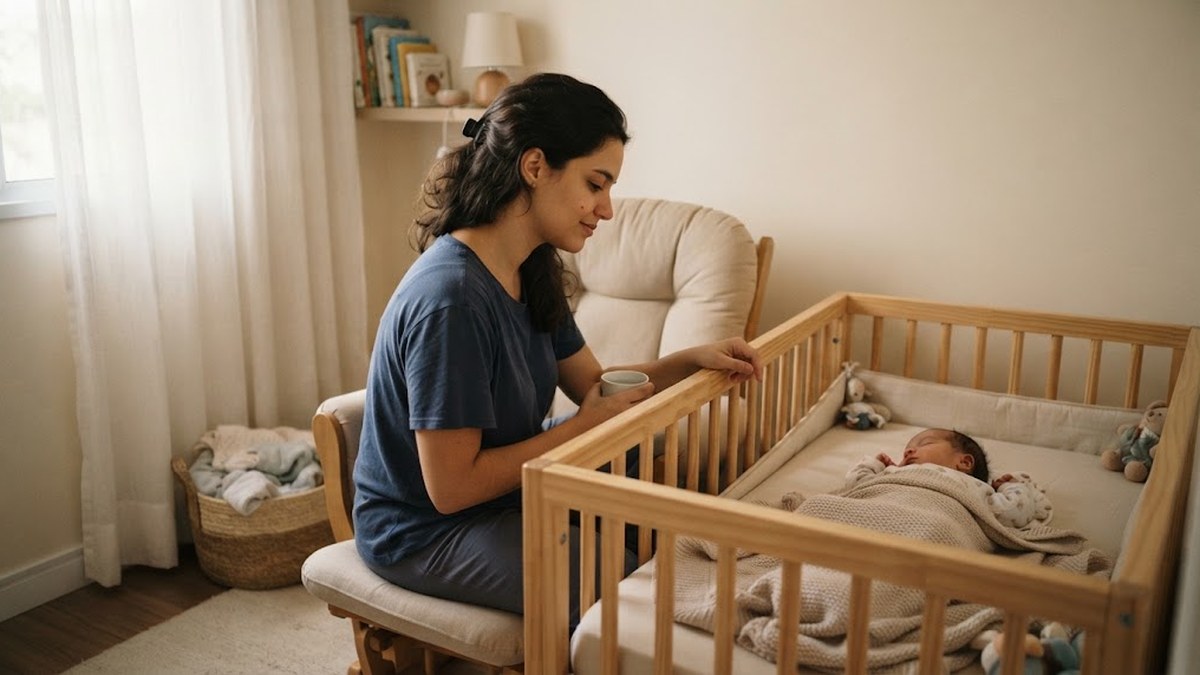
How to Help Your Baby Sleep Alone in the Crib

When your baby falls asleep in your arms and you try to place them in the crib with all the care in the world, their little eyes often open the moment their body touches the mattress. I spent many nights in that cycle, convinced something was wrong with me. Over time I understood that sleeping alone isn’t a talent a baby either has or doesn’t have — it’s a skill that is built slowly, through repetition, cuddles and a lot of patience.


Why your baby resists the crib so much
In the first months, your baby comes from a cozy, warm place with the constant sound of their mother’s heartbeat. Your arms, to them, mean safety and continuity. The crib, on the other hand, is flat, silent and cool. It isn’t fussiness or a whim when they complain about being placed there. It’s their alarm system saying that a change of environment has altered something important.
On top of that, a baby’s sleep is much lighter than ours. They spend a good part of the time in light sleep, the kind where any change in temperature or position bothers them. So when warm arms hand the baby over to a cool sheet, they wake easily. Understanding this mechanism makes a difference, because the answer isn’t to push harder, but to make the transition less frightening.
When to start working on crib sleep
There’s no right age for every baby, but most respond better once sleep starts to organize into more predictable blocks. This usually happens around 3 to 4 months, when the day-night rhythm is more defined. Before that, cuddles are necessary and don’t spoil anything.
It’s worth starting the habit little by little, with no deadline. Some signs that it’s time to try:
- your baby already has a minimal routine, with similar sleep times;
- they sleep well at some moments and wake constantly at others;
- you are exhausted and cuddles have become a constant need;
- your baby already shows they can calm down a little on their own.
Looking at your baby’s stage helps more than following a rigid method. A very simple sleep routine by age already lays the foundation for crib sleep to work better.
Step by step to put your baby in the crib without waking them
The secret lies in the details, not in a single trick. Try these steps in order:
- Warm the crib. A heat pack or a warm cloth diaper for a few minutes makes the sheet pleasant. Remove it before laying your baby down, for safety.
- Wait for deeper sleep. If your baby has just fallen asleep, the arm feels heavy, breathing slows and the little hand relaxes. That’s the best moment.
- Lay the feet down first. Place the bottom and legs on the mattress before the head, to avoid the sensation of falling.
- Keep contact. Leave your hand on the back or chest for a few moments, with light pressure, before moving away.
- Step away slowly. Move your hand away gradually and wait a bit before leaving the room.
Practical tip: blend the scents. Leave a shirt you’ve already worn near the crib or use the same sheet for a few days without changing it every time. The familiar smell of the mother calms and makes the crib seem less strange. It’s also worth placing your baby drowsy but still awake for at least one of the day’s naps.
What to do when the night won’t cooperate
There are nights when nothing works, and that’s part of it. On those days, pick your baby up, offer cuddles and try again later, without guilt. Insisting when your baby is very agitated only adds to everyone’s tiredness.
Another important thing is to adjust daytime naps. A baby who sleeps poorly during the day arrives at night exhausted and with more difficulty falling asleep. If your baby is in the transition phase, the article on a baby who only sleeps in your arms helps you understand this path without abrupt shortcuts.
It’s also worth looking at the environment. A good nursery prepared for sleep, with low light, constant noise and a mild temperature, does more for sleep quality than any technique. When the environment is right, the work of transitioning to the crib pays off much more.
Frequently asked questions
Can leaving my baby in the crib be harmful?
If a baby is left alone crying hard for long periods, that isn’t recommended. The goal is to comfort your baby in the crib, staying close, speaking softly and offering your hand. You don’t need to leave them crying without support for them to learn to sleep.
From what age can I start?
There’s no fixed age. Many babies respond better between 4 and 6 months, when sleep already has more structure. Before that, cuddles and night feeds are normal and help your baby self-regulate.
What if my baby only sleeps in the crib for 20 minutes?
Short naps are common at the beginning. Try to calm and settle your baby again without turning on the light. With repetition, the time tends to increase. If this drags on for weeks and your baby seems very irritable and unrested, it’s worth talking to the pediatrician.
Teaching your baby to sleep alone in the crib is a process, not a test. Remember that regressions exist and that setbacks are part of the journey. These guidelines do not replace a consultation with the pediatrician. If your baby is under one year old and any doubt arises about sleep, breathing or weight gain, always talk to whoever follows your baby closely.
Ferramentas grátis para esta fase
- Calculadora de idade gestacional e data do parto Descubra em quantas semanas você está e a data provável do parto.
- Contador de contrações (trabalho de parto) Cronometre a duração e o intervalo das contrações.
- Calculadora de IMC (e ganho de peso na gravidez) Calcule o IMC e veja a faixa de ganho de peso de referência.