Fever in babies: when to go to the emergency room
The first time my son had a fever, the thermometer read 38.5 and my heart raced. I searched the internet, got lost in a thousand different answers and only later understood what really matters: the baby’s age and the way they are behaving. That is what I will explain here, without alarmism and without a recipe, because fever in a small baby is a serious matter.


Fever in a small baby is always a doctor’s matter
Before anything else: if the baby is under 3 months old and the temperature reached 38 degrees or more, seek care now. Don’t wait for it to pass, don’t give a cold bath, don’t try to medicate on your own. At this age the defence system is immature, and the fever can indicate an infection that needs to be assessed urgently.
Remember this: in a newborn and a baby up to 3 months old, fever is a case for the emergency room, even if they are feeding and sleeping well. Call the paediatrician or go straight to the emergency service.
How to measure a fever the right way
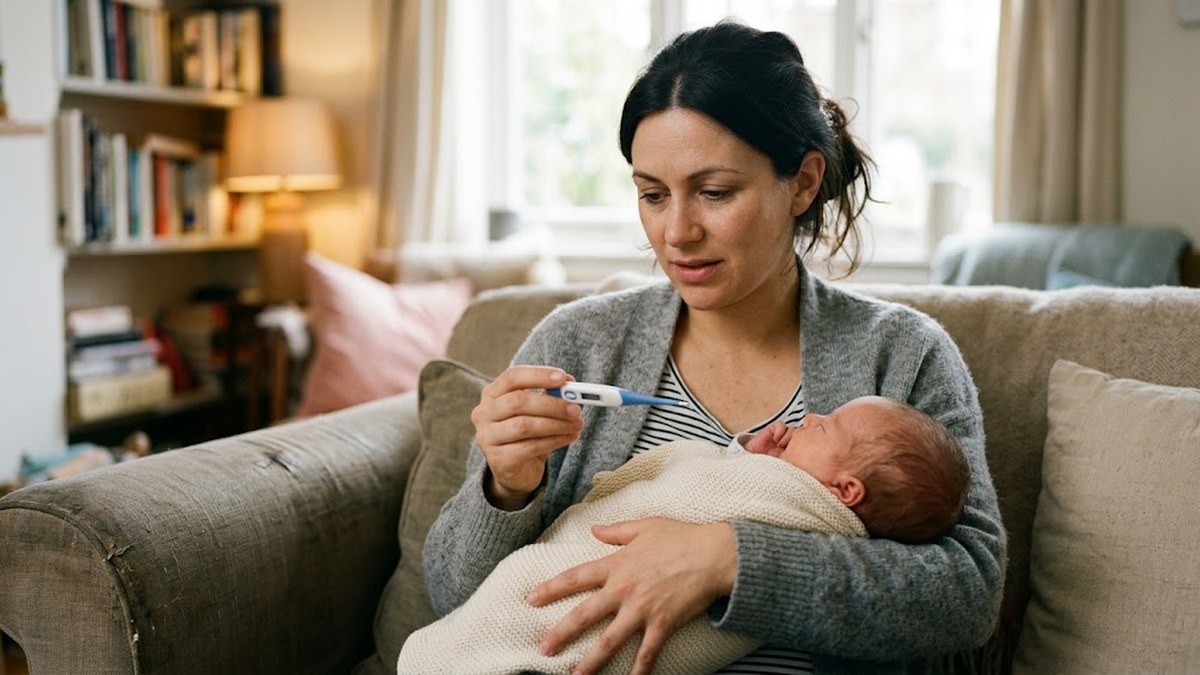
The most reliable way in a baby is the axillary temperature, with a digital thermometer. Press it firmly into the armpit, with the arm held against the body, and wait for the beep. Forehead and ear thermometers can vary a lot in a small baby.
- Up to 37.5 degrees: no fever.
- From 37.8 degrees: a feverish state or low fever, depending on what the paediatrician defines for your baby.
- From 38 degrees: fever. In a baby under 3 months old, that already means medical care.
Always measure with the baby at rest. After feeding, crying or being too wrapped up, the temperature rises on its own and then returns to normal.
It is worth comparing the number with the behaviour. A baby who sleeps much more than usual, who refuses to feed or who cries in a way different from normal deserves attention, even with a low fever. A baby who feeds well, plays and smiles at 38 degrees usually needs an assessment, but not panic.
When to go to the emergency room right away
Run to the emergency service, or call SAMU (Brazil’s public emergency medical service) by dialing 192, if the baby has any of these signs:
- Under 3 months old with 38 degrees or more.
- Very floppy, hard to wake, not reacting to your touch.
- Shortness of breath, fast breathing or wheezing with effort.
- Purple or red spots on the skin that do not fade when you press them.
- Repeated vomiting, total refusal to feed or little urine in the diaper.
- Inconsolable crying or moaning.
- Seizure, a stiff body or tremors.
- A stiff neck or a very bulging soft spot.
If you have any doubt about the severity, call the paediatrician or the health unit and describe the signs. Many people avoid going to the emergency room out of fear of seeming to overreact, and that fear cannot weigh more than the baby’s health. In an emergency, SAMU on 192 guides you on what to do until the team arrives.
What to do at home while you seek help
- Measure the temperature and note the time. The paediatrician will want that information.
- Remove excess clothing. A house that is too warm stops the body from losing heat.
- Offer the breast or the bottle often, because liquid helps keep the baby hydrated. If you are struggling at this stage, it is worth reviewing breastfeeding in the first days.
- Keep the room airy and the clothes light.
- If you can, call the paediatrician or the health unit before leaving and follow their guidance on where to go.
One thing I learned in practice: the baby’s general state says as much as the number on the display. A baby at 38 degrees who feeds and is bright-eyed worries less than a baby at 37.8 who is apathetic. And it is also worth not confusing things: a lot of crying with pulled-up legs can be colic and not fever, so you can check how to tell if your baby has colic before drawing conclusions.
Nights with fever tend to be more restless. If your baby already wakes several times, knowing what to do when the baby wakes at night helps you not turn tiredness into panic.
What not to do
- Do not give medicine on your own, and do not use a dose you saw on the internet. The dose of a fever reducer in a baby is a doctor’s decision.
- Do not give a cold bath or an alcohol compress. Both can make things worse.
- Do not wait for the fever to come down to seek help when the baby is under 3 months old.
- Do not measure the temperature over clothing or right after a bath, because the result is misleading.
Also be careful with internet recipes, such as wrapping the baby in a blanket to sweat out the fever. Sweating does not cure an infection and it also dehydrates the baby. The body needs to lose heat, not keep it.
Frequently asked questions
Does a high fever harm the brain?
Fever from an infection does not burn the brain. What is worrying is the cause of the fever and the baby’s state. A fever above 41 degrees or a febrile seizure needs immediate assessment.
Can I give a lukewarm bath to bring the fever down?
A lukewarm bath, with water at body temperature, can bring relief when the baby is very uncomfortable. Never use cold water, alcohol or an ice pack. When in doubt, follow the paediatrician’s guidance.
If the fever goes away on its own, do I not need a doctor?
It is still worth talking to the paediatrician, especially if the fever returns, lasts more than 48 hours or comes with other symptoms. A fever that comes and goes is common, but it is the doctor who decides whether tests are needed.
Fever is scary, and that fear is legitimate. But with a thermometer in hand, age taken into account and attention to the baby’s behaviour, you make the right decision with much more confidence. And remember: when it comes to a small baby, seeking care is never an overreaction.
Ferramentas grátis para esta fase
- Calculadora de idade gestacional e data do parto Descubra em quantas semanas você está e a data provável do parto.
- Contador de contrações (trabalho de parto) Cronometre a duração e o intervalo das contrações.
- Calculadora de IMC (e ganho de peso na gravidez) Calcule o IMC e veja a faixa de ganho de peso de referência.